BY ALICE WELLS
Contributing Editor
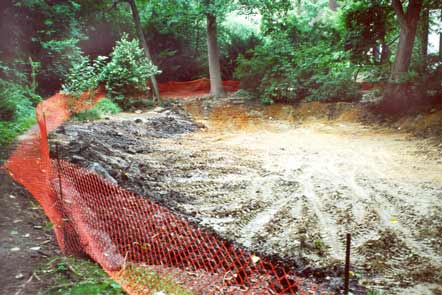
In July, an unexpected swath of black rutted earth was cut through high dense shrubs where an equally startling secluded woodland path used to be. At the end of the scar, a yellow bulldozer leaned on the edge of an empty, muddy bowl, known as the BioPond, near the south edge of Penn's campus.
 Appearances to the contrary, Penn's little-known pocket forest, complete with a reedy scummy pond and ducks, nestled behind the Goddard Laboratories on Hamilton Walk, is not about to become a parking lot, or anything else.
However, the future of the sunnier parts of the Botanic Garden and greenhouses hangs in the balance, depending upon the placement of a proposed Life Sciences Building, replacing Mudd Biology Research Laboratory, the Kaplan Wing and three greenhouses, and extending south, possibly to Guardian Drive. The new building will be large in order to accommodate both the Biology and Psychology departments. At several stories high - the exact number and placement has not yet been determined - it inevitably will block afternoon sun in the mini, urban arboretum.
"Ever since I've been here the site has been at risk," said Tracy Biford, who oversees the Botanic Garden and greenhouses. "They were looking at it in the 1980's for a chiller plant."
Since there is no longer a Department of Botany, the garden no longer has a strong advocate built into the University's academic structure. The Botanic Garden, usually just called 'the BioPond' is under the aegis of the Biology Department.
Back in July, as water slowly drained from the pond, a team of pond professionals - men in rubber waders - stepped enthusiastically into the black muck and scooped startled fish, frogs and turtles into nets. To everyone's surprise, two eels were among the captured critters.
The underwater residents have been transported to a country retreat while the pond is being refurbished. The family of Mallard ducks was captured and released on Darby Creek in nearby John Heinz National Wildlife Refuge.
Ponds naturally fill in over time, and this hundred-year-old, manmade pond in the Biology Department's Botanic Garden was no exception. The center of the pond had shrunk, over the years, to only three feet deep, with four feet of mucky sedimentation below; and the pond leaked, requiring water to be constantly replenished.
Biford, who studied Biology at Penn in the seventies, is nervously pleased by an opportunity to revitalize the pond and surrounding area, thanks to a generous donation from the Kaskey family.
Old muck has been dug out and a new clay liner will be installed. This fall a packed gravel path to accommodate wheelchairs will be built down to and around the water's edge. Along the path will be a low wall for sitting and pond watching. The new pond will be somewhat smaller, but more accessible. Biford said staff at Children's Hospital are looking forward to bringing patients there for an outing.
Before the pond is refilled in November, "clean, intentional muck" will be put back around the edges to support aquatic plants, and also to discourage small children and rambunctious Penn students from wading in, according to Biford. Landscape architects are still finalizing the design, but Biford expects that a bio-filter and pump will be installed nearby to de-chlorinate the water and send it tumbling over rocks, into the pond, getting aerated on the way. The new walkway around the pond will have a bridge over the mini waterfall.
Biford's concern now is minimizing destruction to specimen plants, century old trees, and wildlife, while the improvements take place. And, in the back of her mind is the realization that this will be nothing compared to the impact of the new Life Sciences building expected to be built in a year or two.
Sunny garden space west of the greenhouses will be lost (including a thirty foot tall Pacific Redwood). And land on the pond side likely will be trampled by construction equipment, if not taken up by the new building or shaded by it.
Currently, the sunny area around the greenhouses sports banana trees, lilacs, an herb garden and other beautifully colored flowering plants, including thirteen-year-old wisteria and hibiscus. They are in sharp contrast to the deeply shaded forest around the pond, already squeezed in by tall buildings and hundred year old elm and poplar trees.
"In an urban garden, sunlight is at a premium," said Biford.
Andrew Binns, chair of the Biology Department, said architects are still developing a program for the building and will take sunlight and construction approaches into consideration, for minimum impact on the garden west of the path alongside the greenhouse. But, yes, he said some trees would come down.
Biford, aware of the department's need for space, is gloomily expecting five stories. This summer, surveyors and contractors have been swarming around taking measurements and boring samples over a territory much larger than she thought would be impacted. According to Binns, they need to know about soil composition and how high the water table is some distance from the building, to insure its stability and to know where best to place what.
Biford had expected the greenhouses will be rebuilt south of the garden, along Guardian Drive and University Avenue, where a Penn waste facility is now located. Binns was not sure of that. He said there have been several proposals for where to put them.
Decisions on the final design for the area will be made by the University Provost and a building committee chaired by David Balamuth, assistant dean of the School of Arts and Sciences, according to Binns. A spokeswoman for the Office of the Provost would only say that plans are not yet finalized.
Originally five acres, the garden is now about two acres and shrinking. At one point, it had eight greenhouses, two ponds, and over 2000 plant species. A hundred years ago it blended onto an unused, wooded section of the Woodlands Cemetery and a secluded ravine between the two became a student amphitheater in 1915. Then, in 1936, the University Avenue continuation of 38th Street sliced through the ravine. Buildings sprouted into the back of the garden on University Avenue.
Earlier in the 1900's it already had been reduced to three acres when the Zoological Laboratory, now Leidy Biology Labs, was built on Hamilton Walk along with medical school buildings to the east. Thirty years ago it seemed the tide might be turning when a parking lot behind Leidy actually was re-converted into a garden when Mudd was built.
Back in the 1700's, Botany was included in the study of Medicine and Philosophy. When the University of Pennsylvania moved to its current location, after the war with England, its Center City garden did not come with it. In the second half of the 1800's, interest renewed in having a botanical garden. By then, Botany had moved from Medicine to the "Biological Department."
Not until the 1890's was financial backing and land that was once part of the Woodlands available. Eli K. Price, the lawyer who owned the Woodlands Cemetery (the grounds were originally developed by William Hamilton as a botanical center), endowed a Botany Chair in the Biological Department. Price was on the University's Board of Trustees and wanted to perpetuate Hamilton's botanic legacy.
The original garden included plots for students' use. It extended up to Pine Street, which was later closed to traffic and turned into Hamilton Walk on the suggestion of Botany Professor John MacFarlane, who oversaw the garden's original development. Windows in the Quad used to look out on the Botanical Garden.
Currently the garden and pond are used more as a pleasurable oasis by students and staff than for scientific endeavor, although there are still numerous old and unique specimens. It is open to the public. Area school children - and other groups - may arrange a guided tour.
The greenhouses, which have been moved and rebuilt several times, are used to grow plant samples for environmental studies and plant biology courses, as well as for research into the molecular composition of plants by the Institute for Plant Sciences. Biford marveled that her gardeners were growing broccoli to be ground up and observed under a microscope but some of the researchers didn't even know what the growing plants look like.
Two full-time gardeners and two part-time student gardeners work with Biford. It takes one person all day to move sprinklers around and water the garden, once or twice a week. During the draught last summer, they were coming in at night. An underground sprinkler system is on Biford's wish list. (On a smaller scale, she said, park benches are a welcome donation and a lovely way to celebrate a friend.)
In the three greenhouses they care for student and research projects, as well as starting annuals and perennials. They have labeled all the plants in the garden and maintain a website with gardening information and the Botanic Garden's history.
The south end of the garden is more formal, with a lawn, a small grove of Birch and Boxwood trees, a wide-girthed English Elm tree and a colorful butterfly garden. Picnic tables and benches invite strollers to rest and enjoy lunch. Large groups can rent the area for outdoor parties and barbecues.
But many students and staff at Penn don't know the garden exists.
"When they discover it and ask, 'How long has this been here?' I point to a seven-story-high tree and say, 'that long,'" said Biford.
If you haven't been there yet, the BioPond and garden can be accessed off of Hamilton Walk, at 38th and Baltimore Avenue. Follow the walkway between the first two buildings on Hamilton Walk, east of 38th Street.
Residents of Larchwood Avenue may enjoy the graceful, four-story high Larch tree behind Goddard Hall. There also are Katsura, Himalayan Pines, huge Southern Magnolia, 25 year-old Rhododendron, Dawn Redwood from China, Witch Hazel, tall Beeches, White Mulberry with healthy knobs and knees, and too many more to name.
The web site is www.sas.upenn.edu/biology/biopond/index.html
THE BIO POND ON PENN'S CAMPUS
8/30/2000
To the Editor:
I am writing to reassure the West Philadelphia community that our beautiful BioPond will continue to be a restful oasis on the Penn campus. I am afraid that your story, "BioPond to be rebuilt, but garden's future is uncertain" (8/23/2000) by Alice Wells left many readers with the wrong impression. Every member of the committee responsible for the building of a new Life Sciences facility is acutely aware of the need to preserve this unique retreat in the center of the city. The BioPond has many forceful advocates on our committee including Dr. Andrew Binns, chair of the Biology department. Both Dr. Binns, who was interviewed by Ms. Wells and gave her assurances about the BioPond's future, and Ms. Tracy Byford, who oversees the Garden and greenhouses (and whose name was consistently misspelled in your article) are working hard to restore and enhance it.
I hope that everyone in the community will join us in May when the frogs and eels return to their habitat and the BioPond reopens as the James Kaskey Memorial Park.
Sincerely,
David Balamuth,
Associate Dean of the School of Arts and Sciences and
Chairman, Life Sciences Building Committee