Penn plans construction in Bio Pond area despite public outcry
By Bernard Vaughan
Special to the University City Review
In recent weeks the University City Review has been deluged with emails and letters from students, garden workers, community members and even Penn faculty declaring their opposition to the construction of the new Life Sciences building. The building will be on the western edge of the Bio Pond Garden, where the greenhouses currently are, and many feel the building's construction and presence may be detrimental to the garden's health. Despite this growing concern, school officials insist there is no way construction will not go on as planned next summer.
 "The decision to build phase one on this site is final," said Dr. David Balamuth, Associate Dean of Penn's School of Fine Arts and Sciences.
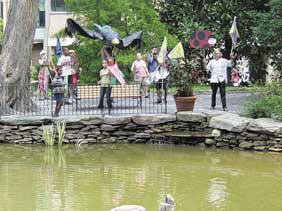
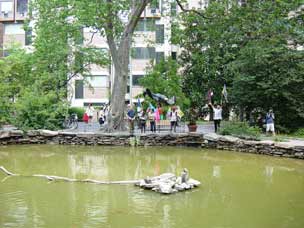
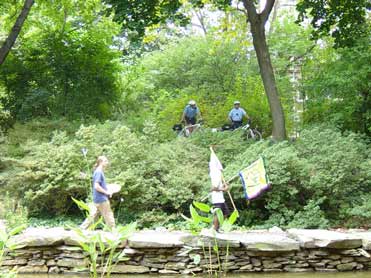
Located on 38th Street, across from the VA hospital, the Bio Pond Garden is a small, albeit lush oasis replete with a wide array of exotic flora and faunamuch of it discreetly and conveniently labeledwherein you feel you are in a rainforest, not in University City, the presence of which is reduced to barely audible car horns and police sirens that hardly compete with the chorus of birds in the garden trees. It is a favorite refuge for students, faculty and community members from their work and the loud urban environment of the neighborhood, where they can eat lunch, take a walk on one of the many trails that intertwine the garden, view the large gold fish in the pond, or just sit down on a bench and unwind.
Despite the school's decision, those against the construction are voicing their concern with the new building's impending impact on the garden, which has been repeatedly reduced in size due to construction since its fiveacre inception over 100 years ago.
Bio Pond gardener, Tracy Byford, says the building in its completion won't take up much garden space, but that the construction process and the increased amount of shade the building will cast is what will damage the garden. "The problem is that construction and gardens aren't a very good marriage," said Byford, "the gardens always lose."
Byford, who has worked at the garden for 22 years, says she is sympathetic to the University's underlying excuse for the building, which will house the Biology and Psychology departments- to compete scientifically with other institutions. Still, she is convinced another location could have been found, and she believes it is the potential for profit, more than science, that is the underlying force behind the construction.
"What's driving this is what drives everything in the world and that is the great god of money," said Byford. "If you can attract scientists and give them a better research place, you can attract higher grants and make more money."
Ann Dixon, also a gardener for the Bio Pond Garden, raised important questions in an email to the University City Review . Will construction workers park their vehicles inside the garden? The new building will take up space used to store gardening supplies; will a new supply space have to be built further inside the garden? Will the construction cause damage that won't be evident until many years after its completion?
Posed these questions, Dr. Balamuth said that these problems are still being dealt with, but he insists there will be a plan so that the construction will minimize any potential damage to the garden.
Dr. Andrew Binns, chairman of the Biology department, said many plants and treessuch as a redwoodwill be transplanted to other parts of the garden, while others, if they are not valuable enoughsuch as some paper mulberry and oak treeswill be cut down. In the long run, he says the garden will be fine.
Many visitors to the Bio Pond Garden are members of the non-Penn surrounding neighborhood, and some see the controversial construction as another example of how the University seems to disregard this community.
"I think a lot of the community feel that there's a wall being put up between them and the garden," said Byford of the fivestory project. "I think they feel this is just another example of Penn's damaging or excluding the community."
Joan Gianninni, who not only works at the garden but also grew up in the surrounding neighborhood, agrees with this sentiment.
"I grew up in the neighborhood and watched Penn just sort of come in and barrel all over everything, and really not ever take the neighborhood into account," Gianninni said. "They say they do, which is interesting, but they never really do."
Asked if the University asked for any input on the construction of the Life Sciences building from the nonPenn surrounding community, Dr. Balamuth replied, "I have nothing really to say about people outside of Penn and how that might be managed."
See The Bio Pond Pages @ www.ucreview.net